To buy a license you MUST have a license account.

If you have purchased a Florida license in the past, most likely you already have an account.

To confirm you have an account or to create a new free account you MUST go to GOOUTDOORSFLORIDA.COM. You will be required to enter your social secuirty number.

IMPORTANT

Be sure to confirm the accuracy of your name and Social Security Number BEFORE you SAVE.

Be sure to Click SAVE when you are done.

After you create your account, do not purchase a license. You are done, and we will now be able to sell you a license.

If you have errors that you are not allowed to correct online you MUST call 855-779-5907 to make any corrections.

Step 1

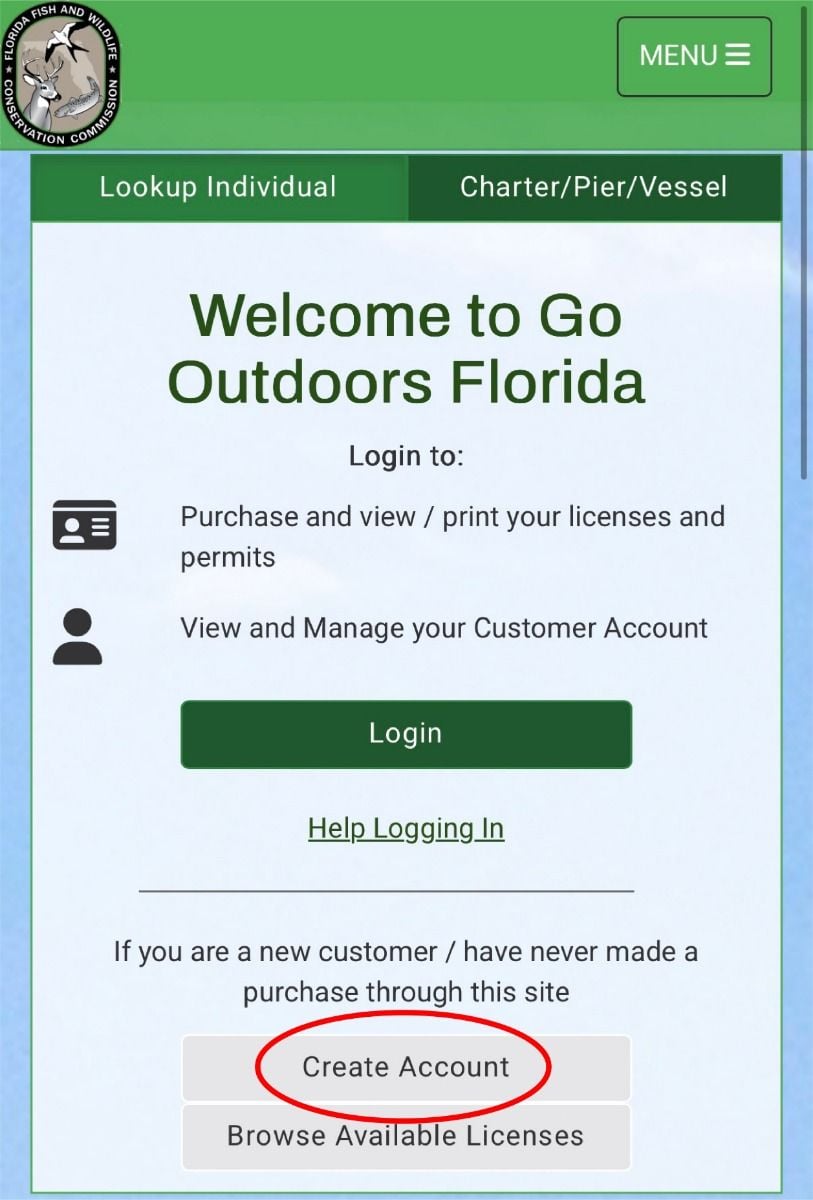
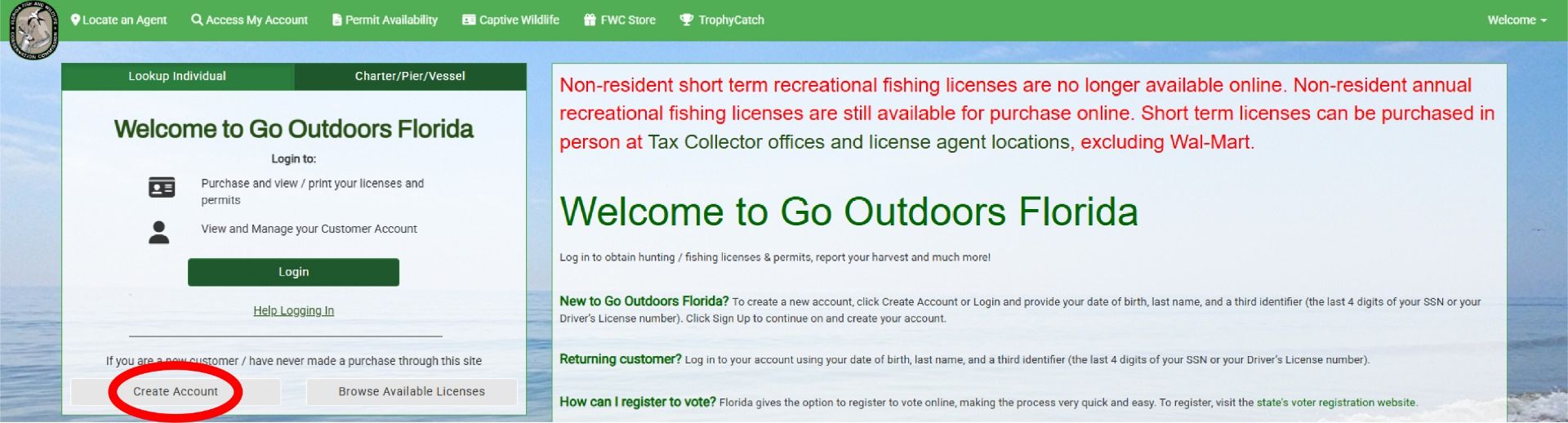
Click “Create Account”

It will walk you through creating a new account.

fl3-web
326584680_561892879196337_1952539038398813425_n

Destin Fishing Seminars Start in February

Each Month we will be teaming up with Legendary Marine in Destin to bring you our Sportsman Seminar Series! These 100% Free Fishing Seminars are put on by our very own Destin Fishing Veteran Tim Broom.

Our Hours Have Changed

New Store Hours:

MON-SAT: 7am-5pm

SUN: CLOSED

To buy a license you MUST have a license account.

If you have purchased a Florida license in the past, most likely you already have an account.

To confirm you have an account or to create a new free account you MUST go to GOOUTDOORSFLORIDA.COM. You will be required to enter your social secuirty number.

IMPORTANT

Be sure to confirm the accuracy of your name and Social Security Number BEFORE you SAVE.

Be sure to Click SAVE when you are done.

After you create your account, do not purchase a license. You are done, and we will now be able to sell you a license.

If you have errors that you are not allowed to correct online you MUST call 855-779-5907 to make any corrections.

Step 1

Click “Create Account”

It will walk you through creating a new account.

FL3-comp1
326584680_561892879196337_1952539038398813425_n

Destin Fishing Seminars Start in February

Each Month we will be teaming up with Legendary Marine in Destin to bring you our Sportsman Seminar Series! These 100% Free Fishing Seminars are put on by our very own Destin Fishing Veteran Tim Broom.

We will be covering seasonla topics that vary month to month to make sure you're ready to catch whatever is biting. See the full topics schedule by clicking the Learn More button below.

Our Hours Have Changed

New Store Hours:

MON-SAT: 7am-5pm

SUN: CLOSED

To buy a license you MUST have a license account.

If you have purchased a Florida license in the past, most likely you already have an account.

To confirm you have an account or to create a new free account you MUST go to GOOUTDOORSFLORIDA.COM. You will be required to enter your social secuirty number.

IMPORTANT

Be sure to confirm the accuracy of your name and Social Security Number BEFORE you SAVE.

Be sure to Click SAVE when you are done.

After you create your account, do not purchase a license. You are done, and we will now be able to sell you a license.

If you have errors that you are not allowed to correct online you MUST call 855-779-5907 to make any corrections.

Step 1

Click “Create Account”

It will walk you through creating a new account.

fl3-web
326584680_561892879196337_1952539038398813425_n

Destin Fishing Seminars Start in February

Each Month we will be teaming up with Legendary Marine in Destin to bring you our Sportsman Seminar Series! These 100% Free Fishing Seminars are put on by our very own Destin Fishing Veteran Tim Broom.

Our Hours Have Changed

New Store Hours:

MON-SAT: 7am-5pm

SUN: CLOSED

To buy a license you MUST have a license account.

If you have purchased a Florida license in the past, most likely you already have an account.

To confirm you have an account or to create a new free account you MUST go to GOOUTDOORSFLORIDA.COM. You will be required to enter your social secuirty number.

IMPORTANT

Be sure to confirm the accuracy of your name and Social Security Number BEFORE you SAVE.

Be sure to Click SAVE when you are done.

After you create your account, do not purchase a license. You are done, and we will now be able to sell you a license.

If you have errors that you are not allowed to correct online you MUST call 855-779-5907 to make any corrections.

Step 1

Click “Create Account”

It will walk you through creating a new account.

fl3-web
326584680_561892879196337_1952539038398813425_n

Destin Fishing Seminars Start in February

Each Month we will be teaming up with Legendary Marine in Destin to bring you our Sportsman Seminar Series! These 100% Free Fishing Seminars are put on by our very own Destin Fishing Veteran Tim Broom.

Our Hours Have Changed

New Store Hours:

MON-SAT: 7am-5pm

SUN: CLOSED

Spring/Fall/Winter Bay Fishing

Spring/Fall/Winter Bay Fishing
Loading... Edited Loading... 2549 view(s)
Spring/Fall/Winter Bay Fishing
The best bay fishing happens during the spring, fall, and winter seasons when the fish range from the flats to deepwater and beyond. For variety we have redfish, speckled trout, white trout, sheepshead, black drum and flounder. In some years there can be a good supply of spanish mackerel. 

Where

The key to bay fishing is access. In the Destin area, there are many places you can access by foot, but your best bets are by boat or kayak.

SFWBay-01

Land Based

  • Wading between the Destin Bridge and the Coast Guard Station
  • Wading the mouth of Joe’s Bayou
  • Fishing the dock at Marler Park in Fort Walton Beach
  • The T-Pier in Valparaiso 
  • Fishing the bridges, Destin, Shalimar Bayou, Cinco Bayou, Tom’s Bayou
  • The 331 Causeway, fishing Bridge and the rock piles around the little 331 bridge
  • The Fort Walton Beach Landing docks
  • Noriego Point

Boat or Kayak Access

  • Mid-Bay Bridge to 4 mile point and Sandestin
  • Joe's, Indian, Jones Bayou, and Mid-Bay Bridge
  • Joe's and Marlet Bayous, Jetties, Coast Guard Station, and Destin Bridge
  • Sandestiin, 4 Mile Point, Mack's Bayou, and Hogtown

Something to look for are seagulls, pelicans and white birds working the area. All are good indicators of fish working schools of bait. Sometimes you’ll just see bait working the surface and other times you’ll actually see the fish busting the surface. As you can see in this picture, there are redfish busting on the surface eating menhaden and the gulls working for scraps. 

SFWBay-07

When you see this happening, you can troll plugs around the schools of fish, not through the middle to drive them deep and turn the bite off. Also, you can cast topwater baits, soft plastics, or spoons. Try and match the size of the baitfish you see for the most bites. Your lure can be smaller in size but not bigger. I’m sure you have heard the term “match the hatch.” It’s not uncommon to see schools like this covering several acres of water at a time and maybe several different schools working in a mile or two area. 

Something to look for are seagulls, pelicans and white birds working the area. All are good indicators of fish working schools of bait. Sometimes you’ll just see bait working the surface and other times you’ll actually see the fish busting the surface. As you can see in this picture, there are redfish busting on the surface eating menhaden and the gulls working for scraps. When you see this happening, you can troll plugs around the schools of fish, not through the middle to drive them deep and turn the bite off. Also, you can cast topwater baits, soft plastics, or spoons. Try and match the size of the baitfish you see for the most bites. Your lure can be smaller in size but not bigger. I’m sure you have heard the term “match the hatch.” It’s not uncommon to see schools like this covering several acres of water at a time and maybe several different schools working in a mile or two area. 

Rods, Reels, and Line

If you’re looking for ultimate performance, try the combination of a Star Seagis Rod, Shimano Stradic Reel, and Power Pro Super Slick 8 braided line. This is one of the lightest weight outfits you can buy! Ultra sensitive so you never miss a bite, extreme casting distance even with the lightest of lures, and virtually no wind knots due to the K-Series guides, super soft braid, and Shimano’s line management system.
Seagis inshore rod series from Star Rods incorporates the latest component technology to create an ultra-lightweight inshore rod with superior sensitivity. Only top quality Fuji® components are used on the fast taper, high-modulus specially processed graphite blank. Fuji’s® SK2 split reel seat gives increased sensitivity while reducing weight. The Fuji® K-Series Tangle-Free guides with Alconite rings are lightweight and shed tangles that occur while using todays popular braided lines. Top quality cork split grips further reduce weight. Weighing in at a mere 3.5oz-4.3oz., Star Rods have set the new standard as the premier inshore fishing rod. There are a total of ten models available in lengths of 6'6", 7', and 7’6".
 
Seagis rods benefit from the use of the New Guide Concept. By reducing guide size near the tip of the rod, weight is reduced in this critical area and more of the imparted energy can be used for casting rather than starting and stopping the rod. Rod response and recovery are noticeably improved and overall rod balance shifts that much closer to the handle.
Stradic utilizes Shimano’s latest technology while drawing on ways of the past. Hagane cold forged drive gear gear combined with X-Ship provides a smooth, powerful and durable reel. The sleek G-Free body provides a better weight balance to reduce fatigue. Every part has been designed to improve the anglers experience on the water.
Power Pro Super 8 Slick Braided Line features an 8-strand Spectra fiber construction, which is specially braided under high tension to create a uniform surface that feels as smooth as silk. The super smooth surface reduces friction and line noise, allowing you to make longer casts with stealth and silence. Designed for anglers who demand high performance using PowerPro’s Enhanced Body Technology process. 
 
The ideal color for fishing the flats, docks, bridges, jetties, flooded timber, stumps, wood and brush piles is Power Pro Super 8 Slick Line in Timber Brown. It’s also an excellent choice for fishing bay waters, muddy or stained water in or around rivers, inlets, and deltas. This is a strong, thin, smooth, and quiet line.

While the setup listed above is for ultimate performance, there are plenty of other options that will work as well.

Pair a 6’6" to 7’6" light to medium light action rod with a 2500 to 4000 sized spinning reel for bay fishing.

Spinning Rods

Spinning Reels

Winter Species

Redfish

251348662_4731159800268733_3481036690276217007_n

Speckled Trout

269970619_4931474883570556_3549658924573850931_n

Flounder

09-13-2018

Sheepshead

Penn-Sheepshead

Black Snapper

30a-mangrove-2

Black Drum

01-23-2019-4

Bluefish

bluefish
SFW-alternatives

Lures, Rigs, and Bait

Popping Corks

Popping corks work great with live baits and many of the soft plastics for Trout and Redfish. Popping corks are mostly used when fishing across the flats in water 2ft-8ft. The length of line between the cork and the bait should be about half the depth of water.
 
Popping corks can also be used around boat docks, heads of the bayous, and river mouth. You can use a variety of soft plastics or live baits under your popping cork. I have even used a very light spoon or a floating topwater bait with some success.
 
Live bait rigs for use on a popping cork should have a Owner 1/0-3/0 Mutu Light and a small split shot. When fishing deeper water like around bridges and boat dock you will need a Carolina rig with Owner 1/0-3/0 and a egg lead 1/0oz-4oz depending on water depth, wind and current. Generally the popping cork rig works better for trout and the Carolina rig is more geared to catch redfish, sheepshead, black drum, and black snapper.

Popping Corks

Popping corks work great with live baits and many of the soft plastics for Trout and Redfish. Popping corks are mostly used when fishing across the flats in water 2ft-8ft. The length of line between the cork and the bait should be about half the depth of water.
 
Popping corks can also be used around boat docks, heads of the bayous, and river mouth. You can use a variety of soft plastics or live baits under your popping cork. I have even used a very light spoon or a floating topwater bait with some success.
 
cajun-thunder-popping-cork-redfish
Live bait rigs for use on a popping cork should have a Owner 1/0-3/0 Mutu Light and a small split shot. When fishing deeper water like around bridges and boat dock you will need a Carolina rig with Owner 1/0-3/0 and a egg lead 1/0oz-4oz depending on water depth, wind and current. Generally the popping cork rig works better for trout and the Carolina rig is more geared to catch redfish, sheepshead, black drum, and black snapper.
 

Soft Plastics

Soft plastics come pre-rigged and unrigged. Some of the best pre-rigged baits are Savage Shrimp, Vudu Mullet, DOA Shrimp, and Mambo Mullet. Pre-rigged are very convenient as you can open the package, tie on, and you are ready to fish. 
 
Pre-rigged can be fished alone or in tandem with a popping cork. If there is one disadvantage to pre-rigged baits, it’s that most are on the lighter side and require fishing light to medium light tackle for them to perform best.
 
Remember when fishing most soft plastic lures it is almost impossible to fish them too slow. While some soft plastics are designed to mimic minnows most are made to mimic shrimp. If you ever watch shrimp in a large tank or in the wild they swim or walk very slowly along the bottom and only move quick when startled. Thus this is why we fish them very slow only giving a quick jerk or snap only once in a while. 
Unrigged soft plastic can be rigged in a variety of ways. You can use them under a popping cork rig. Use a very light 1/16oz jig head for fishing the sand holes on the flats and very shallow water around grass beds and shorelines. They can be rigged on heavier jig heads for for fishing bridges, docks, and channels. Lastly, they can be rigged Texas style on a hook for making swimming baits. This is not normally done with plastic shrimp but more so with swim baits.
 
Some of the most popular unrigged baits are the Z-Man, Berkley Gulps, and Got-cha Sea Striker baits. 
When using any of the soft plastics, hard baits, spoons, and any other lures, it is a good idea to use some scent on these baits. While the Berkley Gulps come with scent it’s not a bad idea to add some more. The most popular scents are made by Pro-Cure. The most effective of the scents is the Inshore, Shrimp, Mullet, Crab and Menhaden Flavors. I would reapply scent after a dozen or so casts. Some other effective scents are the Berkley Gulp spray and Smelly Jelly.
 
At the end of the day you will want some ziplock bags to store the lures that you have used scent on. If you leave the lures tied to your rod and stored in the truck, car, suv, garage, or house you will not be happy the next morning as the smell will be awful. Also most plastic lures are fine when left out. The Berkeley Gulps will dry out and become as hard as petrified wood. While Gulps look and feel like plastic they are actually an all natural product.

Soft Plastics

Soft plastics come pre-rigged and unrigged. Some of the best pre-rigged baits are Savage Shrimp, Vudu Mullet, DOA Shrimp, and Mambo Mullet. Pre-rigged are very convenient as you can open the package, tie on, and you are ready to fish. 
 
Pre-rigged can be fished alone or in tandem with a popping cork. If there is one disadvantage to pre-rigged baits, it’s that most are on the lighter side and require fishing light to medium light tackle for them to perform best.
trout-soft-plastic-doa_1
Remember when fishing most soft plastic lures it is almost impossible to fish them too slow. While some soft plastics are designed to mimic minnows most are made to mimic shrimp. If you ever watch shrimp in a large tank or in the wild they swim or walk very slowly along the bottom and only move quick when startled. Thus this is why we fish them very slow only giving a quick jerk or snap only once in a while. 
 
Unrigged soft plastic can be rigged in a variety of ways. You can use them under a popping cork rig. Use a very light 1/16oz jig head for fishing the sand holes on the flats and very shallow water around grass beds and shorelines. They can be rigged on heavier jig heads for for fishing bridges, docks, and channels. Lastly, they can be rigged Texas style on a hook for making swimming baits. This is not normally done with plastic shrimp but more so with swim baits.
 
Some of the most popular unrigged baits are the Z-Man, Berkley Gulps, and Got-cha Sea Striker baits. 
z-man-flounder-soft-plastic
When using any of the soft plastics, hard baits, spoons, and any other lures, it is a good idea to use some scent on these baits. While the Berkley Gulps come with scent it’s not a bad idea to add some more. The most popular scents are made by Pro-Cure. The most effective of the scents is the Inshore, Shrimp, Mullet, Crab and Menhaden Flavors. I would reapply scent after a dozen or so casts. Some other effective scents are the Berkley Gulp spray and Smelly Jelly.
321557115_1743305026070781_2314163382046919963_n
At the end of the day you will want some ziplock bags to store the lures that you have used scent on. If you leave the lures tied to your rod and stored in the truck, car, suv, garage, or house you will not be happy the next morning as the smell will be awful. Also most plastic lures are fine when left out. The Berkeley Gulps will dry out and become as hard as petrified wood. While Gulps look and feel like plastic they are actually an all natural product.

Hard Baits

Hard baits come in floating and sinking styles. They come in patterns to represent shrimp and minnows and the color patterns are endless to mimic almost any species of bait fish. 
The shrimp style hard baits are all sinking that I have seen which makes sense to me. Two of the most popular baits are the Unfair Rattlin' Shrimp and Yo-Zuri Shrimp. The Unfair Shrimp is the coolest one. You can throw it up along a dock when you jig it to the right and drop it, and it falls to the left so you can make it go under the dock. If you jig it to the left it falls to the right so no matter which side of the dock you are on you can make it go under the dock for those fish hiding under the dock.
 
Minnow style hard baits come in several styles floating, sinking and suspending baits. Of course floating works best in very shallow water, suspending for mid-range depths, and sinking for deep water.
 
They come in minnow shapes, mullet, pinfish and menhaden patterns. The newer baits have become very realistic in the look of the lure. Your choices are both stick and broken back styles.
Spoons and spinners are excellent redfish baits and can be fished around docks, channels and grass flats. Reeling the spoon slowly, bouncing it along the bottom can produce some great redfish action along with some flounder. These lures work great when the water is dirty, while silver will work, the preferred colors are gold and copper. Spoons are some of the oldest lures we have but are still very very effective and will never go out of style.
 
Gotcha lures are one of the most effective lures in you arsenal and not only work for Spanish and bluefish in the bay but are excellent lures at the jetties, surf and pier, Gotcha lures are something that I always have even when heading off big game fishing as i use them around weed line to catch bait for marlin, wahoo, dolphin and tuna. Never leave home without a couple, white with red head and silver with red head are staples worldwide.

The most common technique is “walking the dog” which is a zigzagging retrieve used for various cigar-shaped topwater lures that walk across the water while twitching your rod. You have to have the right rod and reel and the right line to have your lures walk right, a rod that is too light does not produce enough action, a rod that is too heavy produces too much, braided line works best as it is very limp and does not effect the way the lure moves. 

Hard Baits

Hard baits come in floating and sinking styles. They come in patterns to represent shrimp and minnows and the color patterns are endless to mimic almost any species of bait fish. 
 
The shrimp style hard baits are all sinking that I have seen which makes sense to me. Two of the most popular baits are the Unfair Rattlin' Shrimp and Yo-Zuri Shrimp. The Unfair Shrimp is the coolest one. You can throw it up along a dock when you jig it to the right and drop it, and it falls to the left so you can make it go under the dock. If you jig it to the left it falls to the right so no matter which side of the dock you are on you can make it go under the dock for those fish hiding under the dock.
MIRROLURE-REDFISH
Minnow style hard baits come in several styles floating, sinking and suspending baits. Of course floating works best in very shallow water, suspending for mid-range depths and sinking for deep water.
 
They come in minnow shapes, mullet, pinfish and menhaden patterns. The newer baits have become very realistic in the look of the lure. Your choices are both stick and broken back styles.
Spoons and spinners are excellent redfish baits and can be fished around docks, channels and grass flats. Reeling the spoon slowly, bouncing it along the bottom can produce some great redfish action along with some flounder. These lures work great when the water is dirty, while silver will work, the preferred colors are gold and copper. Spoons are some of the oldest lures we have but are still very very effective and will never go out of style.
gotcha-casting_1
Gotcha lures are one of the most effective lures in you arsenal and not only work for Spanish and bluefish in the bay but are excellent lures at the jetties, surf and pier, Gotcha lures are something that I always have even when heading off big game fishing as i use them around weed line to catch bait for marlin, wahoo, dolphin and tuna. Never leave home without a couple, white with red head and silver with red head are staples worldwide.
The most common technique is “walking the dog” which is a zigzagging retrieve used for various cigar-shaped topwater lures that walk across the water while twitching your rod. ‚You have to have the right rod and reel and the right line to have your lures walk right, a rod that is too light does not produce enough action, a rod that is too heavy produces too much, braided line works best as it is very limp and does not effect the way the lure moves. 

Live Baits

No bay fishing lesson would be complete without talking about the value of having good live baits. The most common of all live baits is live shrimp. There are almost no fish that won’t eat a live shrimp. The second best bait is live menhaden the nice thing about live shrimp is that they can be bought, but you have to cast net your menhaden as they don’t live will in captivity for a long period of time. Live finger mullet fall into this same category.

Shrimp

SHRIMP-LIVE-23

Menhaden

BAIT-Menhaden-23
Of course, great live baits include live bull minnows for flounder and live fiddler crabs for sheepshead. The standard of all bay fishing baits is the live pinfish. Again, you have to cast net for live pinfish but they are worth the effort. Lastly, if you really want that huge gator trout it would be hard to not mention the live pigfish. I have spent days before a trout tournament catching enough pigfish to make it through a weekend of fishing. Pigfish are the hardest of all bait fish to come by. You have to catch them by hand rod and reel fishing with tiny hooks and pieces of shrimp over mud bottom and generally catch one pigfish to every 50 pinfish. 

Things to Consider When Fishing Hard Baits

Can you Hear Me?

Some topwater plugs have internal rattles, which telegraph noise and vibration farther than plugs without sound chambers. Rattles are excellent for enticing fish up from the deep or in from the distance. The resulting clacking/clicking vibrations replicate the sounds a frantic injured baitfish makes as it kicks its way across the surface. Sometimes that noise is exactly what pushes a game fish to strike. Conversely, I have experienced times when the rattle plugs have actually kept fish at bay. When fish are leery and seem more sensitive to noise, a topwater plug without a rattle could prove the way to go; sometimes it takes a softer, quieter, more subtle retrieve to get strikes. Keep both versions handy, and give them equal soak time to find out which one the fish prefer. 
rattle1

Stealth Mode

Another effective yet often overlooked trick - particularly in clear water - is keeping your leader out of the water. Again, when fish are off their feed, going with a smaller diameter, lighter leader is a basic adaptation. However, it’s even more effective if most of that leader rides out of the water.I began making long casts and holding my rod tip high over my head while imparting short twitches to create a tight walk-the-dog action. By holding the rod high, I kept most of that 25-pound-test leader out of the water. The strikes started coming, and I believe my tactic had a lot to do with it.
 
121690727_3490802874314946_42037401066224191

Speed it up

When fish are reluctant to strike, try teasing the followers by increasing retrieval speed as soon as you see them behind the lure. When fish are striking with abandon, keep to your original retrieve; it is when strikes are slow in coming that this trick shines.
 
Think about it. If you were a fish that had just charged up behind a lure, and that lure just kept twitching along with no appreciable difference in action, wouldn’t you think something was amiss? In nature, that fleeing baitfish should sense a predator fish coming at it, and the realization that it is just seconds from doom should prompt it to panic. The ensuing change in speed and distress vibrations are what often prompts a game fish into striking, triggering its natural instincts to prey on this weak link - hungry or not.
 
On several occasions, we sped up our lures when fish appeared behind them to create the illusion of their trying to outrun the fish. Between that tease and keeping most of the leader out of the water, several followers were converted into releases.  
SPEED-IT-UP-BLOG1

Causing Commotion

A radical modification, is creating the illusion of a pair or more of baitfish scurrying away from feeding fish. The simplest way to do this is to tie a topwater plug about 3 feet behind a popping cork. Cast the rig and then retrieve it by popping the cork and occasionally letting the rig rest for a couple of seconds. This creates the illusion of a smaller baitfish bird-dogging a larger injured bait. Most of the strikes should come on the smaller rear plug.
 
Another setup is to use the same style, size and color of plugs. To be sporting, and so it poses less risk of injury to angler and fish, remove the hooks on the lead lure. Tie the leader to the lure’s eye. Then tie a 2 or 3-foot leader to the rear eye of the plug, and that leader to the lead eye of the rear plug. You can add a third plug by removing its hooks and adding it to the lineup.
 
With both two and three lures, this rig can be worked in a number of ways, ranging from twitching and pausing under a slow retrieve to a slightly quicker, more radical retrieve with aggressive side-to-side action. While the lead plugs might draw strikes some of the time, it is usually the last plug in line that catches fish.
311693826_5826850050699697_845664762160661698_n

Stopping the Lure

There are occasions, especially during feeding blitzes, when fish refuse to strike a rapidly moving plug. Perhaps the fish become programmed to consume the injured ones that can’t swim off? Fish that aren’t especially aggressive sometimes want an easier target, like a severely injured bait that is barely kicking.
 
I have watched friends convert many a fish by occasionally pausing his lure for a few seconds before picking up the retrieve and pausing the lure again for a few more seconds. This tactic worked well when he pitched a lure right into the blitz, where you would think any quickly fleeing lure would draw strikes.
121966511_3490802934314940_25758010324

Color is Key

As mentioned earlier, matching the hatch in terms of size and coloration is generally a smart move. Yet as much as I subscribe to this theory and stick to my guns, sometimes it takes some experimentation to get the bites. I fish mainly a silver with black-back plug, to imitate finger mullet, and occasionally a menhaden-hued plug. For tannin-stained waters, select colors that offer the most visibility. For example, chartreuse plugs or those with highlights of chartreuse permeates these waters farther than other colors and makes the plugs more visible to fish. The silhouette these colors presents might just be strong enough to stand out to a fish. Add in a little action, and the rest, as they say, might be history - for the fish, that is!
 
Fishing topwater plugs is an art. Sometimes the bite is on, and all that’s necessary is to pitch out the lure. Yet tough times dictate some thinking, and that’s when a lot of anglers give up on topwater lures. For me, watching a fish explode on a topwater plug is one of the neatest sights in fishing, and I’m sure somewhere down deep in my psyche that’s the reason I’m usually the last to retire the lure.
blog-match-hatch1

Trolling the Bay

Trolling the bay requires the least effort but can produce huge dividends. We normally troll around bridges (Mid Bay Bridge), channels (channel around Crab Island) and drop offs (like around the Four Mile Point area).
 
We are always looking for birds working or the redfish exploding on the surface eating baitfish. Many times you will see the birds, redfish, and baitfish all at the same time. At other times you may see just one of the three. In either case troll around them, not right through the middle, as this will sometimes shunt the bite off. The one bird you really want to look out for is the little white birds as these are the best indicators of action. The best plugs for trolling are the Yo-Zuri or Mann’s stretch lures. I prefer the deep divers but often run one shallow running lure. I rig these on on 60lb mono leaders.
You should be trolling around 3-5 miles per hour but another way to tell if you are going the right speed is to look at the rod tip, it should have a vibration to the tip of the rod.
 
Got any other questions about bay fishing? Give us a call at Half Hitch and we’ll help you out.
 
Get the handout here: pdfGCSSS-SFW-Bay-Fishing.pdf
Previous article:
Next article:
Copyright © 2026 Half Hitch Tackle Co. Inc. All rights reserved.